ClojureScript for Skeptics - Derek Slager
In briefDerek Slager's Clojure/conj talk argues that ClojureScript is a pragmatic choice for web development. He addresses common objections, recent improvements, tooling and use cases where it shines.
Page 18 of 41
In briefDerek Slager's Clojure/conj talk argues that ClojureScript is a pragmatic choice for web development. He addresses common objections, recent improvements, tooling and use cases where it shines.
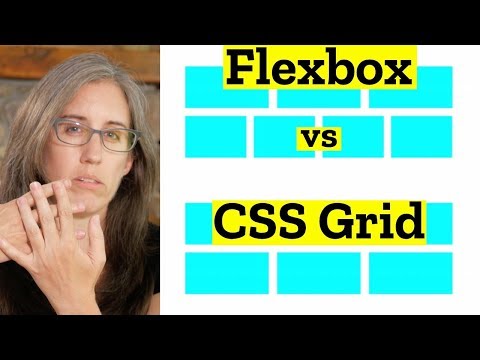
In briefJen Simmons explains the difference between CSS Flexbox and CSS Grid, and when to use each. She makes the case that Grid does not replace Flexbox and most sites use both.
In briefSasa Juric's EMPEX talk demonstrates Elixir and Erlang's process model and what makes the BEAM runtime distinctive, such as fault-tolerant parallelism by design.
In briefCasey Muratori responds on-stream to a dismissive Twitter post by demonstrating how slow Visual Studio's startup and debugger watch window are, comparing it to much older software and machines. It is a long rant about software performance and bloat.
In briefJulien Verlaguet of Facebook describes applying static analysis and type inference to a very large PHP codebase, using OCaml. The work led to the Hack language.
In briefAt CppCon 2017 Herb Sutter presents his work on evolving C++ through compile-time code generation, including metaclasses and reflection. The aim is to make the language both more powerful and simpler by letting programmers express intent directly.
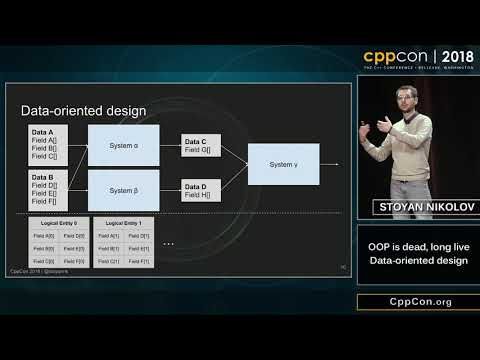
In briefA CppCon 2018 talk arguing that OOP has failed to deliver on reuse and performance, and presenting data-oriented design for C++ with practical worked examples from real systems.
In briefAn overview of the PTVS 2.0 beta feature for debugging Python and C/C++ together in one session in Visual Studio.
In briefChris Lattner's ASPLOS 2021 keynote on the golden age of compiler design in an era of hardware and software co-design, covering compiler infrastructure for accelerators and unifying hardware IRs.
In briefDouglas Crockford's Google Tech Talk explains monads without category theory or Haskell, implementing them in JavaScript and tying them to Ajax and promises. He also touches on odd asides such as coloring code by scope.
In briefBobby Powers presents Mesh, a drop-in malloc replacement that eliminates memory fragmentation in unmodified C/C++ programs by compacting memory. The talk covers how it works despite C's fixed object addresses, and its benefits for programs like Redis.
In briefThe first part of a series on programming in Jai, Jonathan Blow's in-development language. It covers compiling, writing hello world and using code from other files.
In briefIn this first Crust of Rust episode, Jon Gjengset live-codes an example that needs multiple explicit lifetime annotations. Along the way he covers string types and generics over a custom trait.
In briefAlex Martelli's Google Developers Day talk on classic design patterns (creational, structural and behavioral) and how they appear in Python. He stresses that patterns must be studied in the context of the implementing language.
In briefBob Nystrom, author of Game Programming Patterns, gives a Roguelike Celebration 2018 talk questioning whether entity component systems are the only way to structure a game. He walks through alternative architectures drawn from roguelike development.
In briefCliff Click walks through a small performance example on a modern out-of-order CPU. He covers pipelining, ILP, CISC vs RISC, multicore, and why cache misses and the memory subsystem dominate performance.
In briefGlenn Vanderburg asks whether software development can be real engineering, surveying other engineering disciplines and decades of programming experience. He envisions what a software engineering worthy of the name might look like.
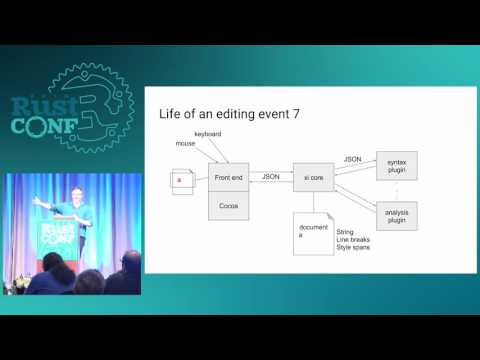
In briefRaph Levien presents Xi editor at RustConf 2016, a high-performance text editor built in Rust. The talk goes into technical details, building polished GUI apps, and running a community-focused open source project.
In briefMatt Ranney of Uber talks at GOTO Chicago 2016 about what Uber learned from growing past 1,000 production microservices. He covers regrets, sprawl and organizational effects.
In briefDan Liebgold of Naughty Dog gives a RacketCon 2013 keynote on using Racket in PlayStation 3 game development. He explains the Racket-based DSLs used for game data and scripting, which replaced the studio's earlier GOAL-based toolchain.
In briefJoe Armstrong's GOTO 2018 talk contrasts the problems computer scientists study with the problems users have. He revisits forgotten great ideas such as tuple spaces, flow-based programming, Xanadu and Unix pipes, with anecdotes.
In briefDaniel Lemire's QCon talk on how simdjson parses gigabytes of JSON per second. It covers SIMD vectorization, branch prediction and the lessons learned building a fast parser.
In briefA 12-minute film in which Erlang's creators demonstrate the language's fault tolerance and live-system features, including phoning each other to show it working. This version has fixed audio.
In briefBisqwit writes a raytracer from scratch in C++ for DOS, rendering in the 16-color VGA palette at 640x480. The video also covers color quantization and ordered dithering.