CppCon 2015: Timur Doumler “C++ in the Audio Industry”
In briefTimur Doumler's CppCon 2015 talk on how C++ is used in the audio industry. It covers the patterns and tools audio developers rely on, including handling real-time constraints.
Page 19 of 41
In briefTimur Doumler's CppCon 2015 talk on how C++ is used in the audio industry. It covers the patterns and tools audio developers rely on, including handling real-time constraints.
In briefAn episode of This Week in Startups in which Jason Calacanis interviews Ruby on Rails creator David Heinemeier Hansson. They discuss startups, bootstrapping and 37signals' approach to business.
In briefSQLite author Richard Hipp's talk at SouthEast LinuxFest criticizing Git's workflow and introducing Fossil as an alternative. He lists Git enhancements and argues for keeping history intact.
In briefLex Fridman's long podcast conversation with Chris Lattner, creator of Swift, LLVM and MLIR and co-founder of Modular. Topics include the Mojo language, the future of programming and AI, and hardware.
In briefChristian Schafmeister's Google Tech Talk on Clasp and CANDO, a Common Lisp implementation on LLVM and C++ used to design molecules, including energy minimization and force-field calculations.
In briefDavid Nolen explains how ClojureScript is used at Vouch.io to build mobile and web software with a single language and REPL-driven workflow. The talk includes a live coding demo of React Native development.
In briefA Google Tech Talk on Yahoo's 14 rules for faster web pages and the YSlow tool. It covers front-end practices like avoiding @import and fixing ETags, with live analysis of popular sites.
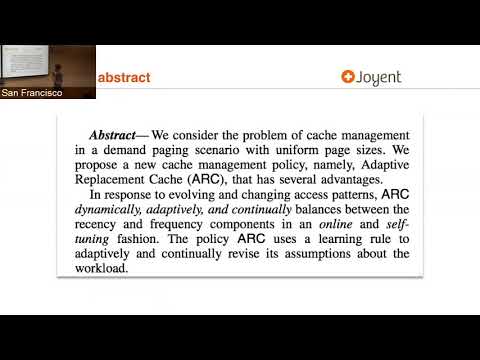
In briefBryan Cantrill presents the ARC (Adaptive Replacement Cache) paper by Megiddo and Modha at Papers We Love. He opens with a survey of caching strategies before digging into the self-tuning LRU/MFU design.
In briefTom Scott and Matt Gray talk at Electromagnetic Field about making Emojli, an emoji-only messenger that began as a joke, how it was built and why they never want to do it again.
In briefHarry Schwartz gives a roughly hour-long tour of Emacs Org mode as an outliner, task manager, markup language and agenda tool. He demonstrates how he uses it for documents, presentations and todo lists.
In briefAaron Hsu shows how to manipulate and transform tree data in APL using arrays and inverted tables instead of pointers. He claims much smaller code, better performance and easier parallelisation.
In briefBrian Warner, author of magic-wormhole, presents the tool at PyCon 2016. He explains how a few secret words let two computers securely transfer files, covering the cryptography (NaCl, SPAKE2) and library use.
In briefDavid Sanders gives the first part of a two-part introduction to the Julia programming language at SciPy 2014. It walks through the language's basics and its appeal for scientific computing.
In briefRob Pike's 2010 talk at OSCON's Emerging Languages Camp on where Go's concurrency style comes from. It traces the idea from Hoare's CSP through Squeak, Newsqueak and Limbo to Go.
In briefLichess founder Thibault Duplessis talks at Big Techday 10 in Munich about how Lichess works and how he built it. He covers the project's origins and technical challenges including cheating detection.
In briefStephen Kell's Strange Loop talk argues that C and Unix already contain Smalltalk-like dynamism and introspection that can be exposed. He presents his liballocs research on bridging dynamic and compiled languages.
In briefSmalltalk pioneer Dan Ingalls presents the Lively Kernel at JSConf US 2012, a live, direct-manipulation programming environment running in the browser. He shows drag-and-drop building of live objects on the web.
In briefNada Amin's Strange Loop talk on programming languages that build on themselves, centered on towers of interpreters and nestable interpretation in Scheme. She shows how interpreters can be stacked and collapsed.
In briefA 1991 NeXT promotional video that stages a head-to-head programming contest between a NeXT computer and a Sun workstation. It shows NeXT's interface builder and object-oriented tooling producing an application far faster than traditional UNIX development.
In briefJohn McCall of Apple's Swift team presents at CppNow 2023 on introducing a memory-safe successor language into large C++ code bases. He argues incremental improvement of C++ hits hard limits and explains Swift's C++ interoperability for gradual migration.
In briefNetanel Rubin's 31C3 talk chains Perl's syntax quirks into a powerful remote code execution attack, taking down popular Perl-based projects.
In briefSimon Peyton Jones presents linear types for Haskell, showing how practical linearity can fit into a higher-order polymorphic language. The talk covers motivations such as resource handling and relates the ideas to Rust.
In briefLuke Wagner of Fastly explains what a WebAssembly component is, how it relates to familiar concepts, and what the Component Model enables. It emphasizes security, composability and modularity.
In briefBryan Cantrill's Craft 2019 talk on the ethical dilemmas software engineers face as software eats the world. He explores cases where engineering thinking conflicts with the law or personal morals, including Facebook's news feed experiments.