Jonathan Blow - How to program independent games - CSUA Speech
In briefJonathan Blow speaks at UC Berkeley's CSUA about how to program independent games. He argues for keeping code simple, avoiding unnecessary work, and shipping.
Page 3 of 41
In briefJonathan Blow speaks at UC Berkeley's CSUA about how to program independent games. He argues for keeping code simple, avoiding unnecessary work, and shipping.
In briefGil Tene of Azul Systems explains common pitfalls in measuring latency and response time, including why averages mislead and the problem of coordinated omission. He introduces open source tools like HdrHistogram for better measurement and reporting.
In briefLinus Torvalds gives a Google tech talk on git, the source control system he created two years earlier. He argues for distributed version control over centralized systems such as CVS and Subversion.
In briefJason Turner's CppCon 2016 talk builds a simple Commodore 64 game using C++17, showing how constexpr and const let a modern compiler produce tight 6502 code. He walks through assembly output to show abstractions being optimized away.
In briefTim Ewald's Clojure/conj talk uses furniture making with hand tools versus machine tools as an allegory for software. It explores how automation changes what we make and how we think about our work, and why Clojure's small set of simple tools matters.
In briefRich Hickey's keynote on software versioning, arguing that breaking changes are the real problem and that libraries should only grow by providing more and requiring less. It critiques semantic versioning and ties into Clojure spec.
In briefChristian Schafmeister's Google Tech Talk on designing spiroligomer molecules and building Clasp, a Common Lisp on LLVM that interoperates with C++, to program molecular design. It covers the chemistry, automatic differentiation for force fields, and how the compiler is built.
In briefRich Hickey's Strange Loop 2011 keynote separates 'simple' (not intertwined) from 'easy' (familiar or near at hand) and argues that software complexity comes from complecting things. It offers a vocabulary for judging designs and abstractions.
In briefA thoughtbot meetup talk by Max Cantor on getting most of what popular plugins provide using only built-in Vim features. It covers autocomplete, file jumping, filesystem navigation, build integration and snippets, with slides and a vimrc available.
In briefCasey Muratori's first refterm lecture lays out philosophies of optimization, distinguishing optimization from non-pessimization, which means avoiding needless work. It uses his fast terminal renderer project to show how fast computers really are.
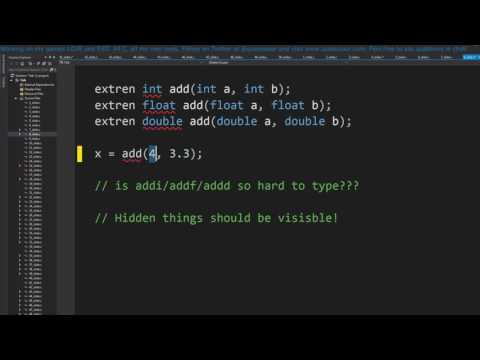
In briefJonathan Blow's first talk on designing a new programming language for games, which became Jai. He explains the problems with C++ and why Go, Rust and D do not fit game development.
In briefMike Acton of Insomniac Games argues that a program's purpose is transforming data, and shows how common C++ approaches work against that in performance-critical game development. He covers cache behavior, data layout and the limits of compilers.
In briefPython core developer Raymond Hettinger explains how Python's dictionary implementation evolved into the compact, ordered dict in Python 3.6. He uses pictures and small bits of pure Python, and covers key-sharing, compaction and versioning.
In briefCasey Muratori's lecture, originally given at the Technical University of Madrid, arguing that Conway's Law is the only viable candidate for a true law of software architecture. He explains how software mimics the organization over time, using examples like Windows' multiple volume controls.
In briefTavis Rudd describes how RSI forced him to program by voice, and shows the Python and Emacs Lisp system he built with voice recognition. A live demo creates and deploys a small system without touching the keyboard.
In briefRaymond Hettinger's PyCon 2013 talk on transforming code into idiomatic Python through a series of before-and-after refactorings. It shows how to use iterators, dictionaries, named tuples and other language features well.
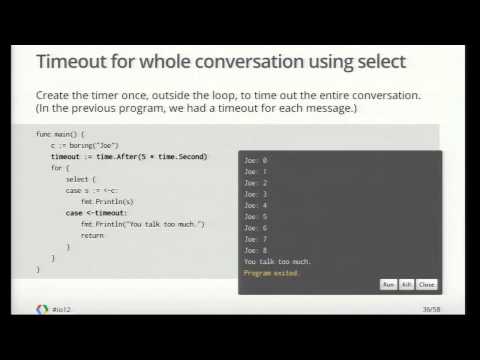
In briefRob Pike's Google I/O 2012 talk shows how goroutines and channels solve tricky concurrency problems with simple Go code. It features a playful goroutine demo with gophers passing messages and a search engine example.
In briefPete Hunt of Facebook and Instagram introduces React at JSConf EU 2013 and explains its design principles. He argues that separating templates from logic only separates technologies, not concerns, and makes the case for components.
In briefPhilip Wadler's Strange Loop talk on Propositions as Types, the link between logic and computation (the Curry-Howard correspondence). He traces its history through Church, Godel and Turing and shows how it shaped theorem provers and programming languages.
In briefDave Thomas, a co-author of the Agile Manifesto, argues at GOTO Amsterdam 2015 that Agile as a branded industry has lost its meaning. He says agile is an adjective, not a noun, and urges developers to reclaim agility.
In briefJack Diederich's PyCon 2012 talk argues that classes are overused in Python and walks through real code, refactoring away unnecessary classes, exceptions and modules. It popularized the heuristic that a class with two methods, one being __init__, should be a function.
In briefEskil Steenberg's two-hour talk on his personal approach to writing C, covering code style, structure, naming, pointers and large-project organization. He warns it contains a fair bit of programming religion.
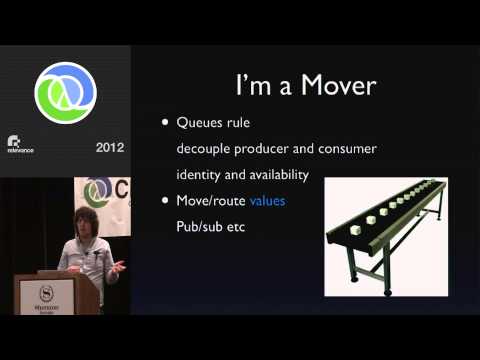
In briefRich Hickey's 2013 talk applies language-design thinking to whole systems, covering names, queues, data, failure, and the interfaces between programs. It ends with a call to action for building systems holistically.
In briefThe first lecture in Bartosz Milewski's category theory series for programmers. It covers the motivation and philosophy behind category theory and why composition matters for handling complexity.