Hawking Radiation
In briefPBS Space Time explains Stephen Hawking's prediction of Hawking radiation and how black holes can emit radiation and slowly evaporate. It goes beyond the common particle-antiparticle analogy.
Page 7 of 25
In briefPBS Space Time explains Stephen Hawking's prediction of Hawking radiation and how black holes can emit radiation and slowly evaporate. It goes beyond the common particle-antiparticle analogy.
In briefAstrophysicist David Kipping presents the halo drive, a proposed way to propel a starship to a good fraction of light speed by gaining energy from a black hole. The video is based on his peer-reviewed paper and explains why energy is the main obstacle to interstellar flight.
In briefMax Tegmark's MIT CBMM talk on why deep learning works so well. He argues that the laws of physics and the symmetries in physical data make it compressible into small neural networks, tying physics to network structure.
In briefPBS Space Time explains the Hubble constant tension, in which two precise, independent methods of measuring the universe's expansion rate disagree. It covers why this calls some standard cosmology into question.
In briefA short, music-driven video built from Neil deGrasse Tyson's remarks on why advancing the space frontier matters, contrasting NASA's small budget with war spending and stressing inspiration.
In briefA very long, detailed look at the A4/V2 rocket turbopump, the steam-turbine-driven twin propellant pump system. It covers the peroxide and permanganate catalysis that drives the turbine. This is part 1 of a series on V2 components.
In briefA segment from Carl Sagan's original Cosmos explaining the fourth spatial dimension through analogy with a two-dimensional world and shadow projection.
In briefPBS Space Time examines the interstellar object 'Oumuamua and the popular theories about it, including the light-sail hypothesis. It argues that a natural rock is the likeliest explanation.
In brief3Blue1Brown explains how holograms record a 3D scene on 2D film, using wave diffraction and phase. The video includes demonstrations of several real holograms.
In briefA concept video from Nokia Research Center and Cambridge Nanoscience Center showing Morph, a flexible, self-cleaning, shape-changing phone imagined through nanotechnology.
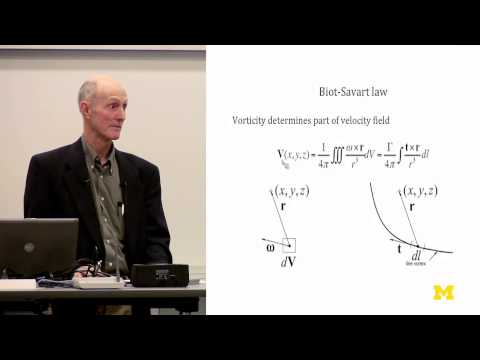
In briefRetired Boeing Technical Fellow Doug McLean walks through common misconceptions in aerodynamics, drawing on his book Understanding Aerodynamics. He critiques popular explanations of wing lift and rocket thrust and argues for arguing from the real physics.
In briefPhysicist Angela Collier's nearly three-hour critique of Richard Feynman's public legacy. She examines how his books, written with Ralph Leighton, shaped a mythologized great-man image, and covers his personal behavior.
In briefA PBS Space Time episode hosted by Gabe Perez-Giz on the nature of spacetime and whether space and time are fundamental. It builds up reference frames and causality in a short, dense format.
In briefPBS Space Time introduces Miguel Alcubierre's warp drive, explaining how spacetime itself could be warped rather than moving a ship through it, and whether it is physically possible.
In briefVideo of the March 2014 Senate Defense Subcommittee hearing on National Security Space Launch programs. Elon Musk of SpaceX testifies alongside ULA's CEO, a GAO official and a policy expert, on launch contracts and Russian engines.
In briefLeonard Susskind opens Stanford Continuing Studies' Theoretical Minimum series with an introduction to quantum mechanics, a course for people who want real physics rather than popularization. It assumes some calculus and linear algebra.
In briefFootage from a camera on a Space Shuttle solid rocket booster from liftoff through descent, with audio enhanced by Skywalker Sound from the original camera microphones. The sound is real, not foley.
In briefA short clip of Richard Feynman answering an interviewer's question about how magnets work, in which he explains why a why-question has no simple answer without a shared frame of reference.
In briefMark Handley of UCL looks at how SpaceX's November 2018 revisions to the Starlink constellation affect network behavior. The video visualizes the orbits and routing and estimates latencies, building on his earlier video and research paper.
In briefRichard Feynman, in a clip from the BBC series Fun to Imagine, takes on the puzzle of why mirrors seem to swap left and right but not top and bottom.
In briefAdam Savage shows a set of Mitutoyo ceramic gauge blocks and uses them to explain metrology, the science of measurement. He argues that accuracy and precision work differently than most people assume, which changes how you think about every measuring tool.
In briefScott Manley explains the plumbing of rocket engines, including pressure-fed, gas generator, expander and staged combustion cycles. He shows why more complex designs exist and what they gain.
In briefSabine Hossenfelder asks whether complex numbers are just a convenient tool or necessary in physics. She discusses a recent paper arguing that quantum mechanics cannot be done with real numbers alone.
In briefA PBS Space Time episode on how the Higgs mechanism gives particles mass, prompted by Fermilab's heavier-than-expected W boson measurement. It goes beyond the usual pop-science treatment without heavy math.