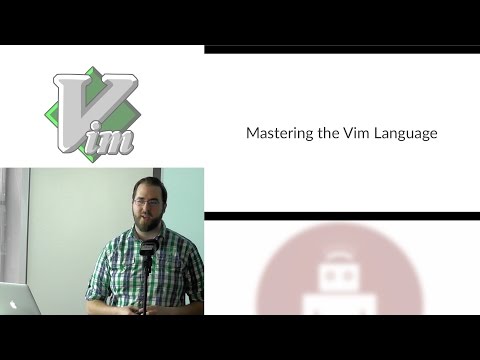
Mastering the Vim Language
In briefChris Toomey of thoughtbot explains Vim as a language of commands, motions and text objects that combine into precise edits. He shows how to master the built-in pieces and extend them.
Page 5 of 41
In briefChris Toomey of thoughtbot explains Vim as a language of commands, motions and text objects that combine into precise edits. He shows how to master the built-in pieces and extend them.
In briefJack Rusher's Strange Loop 2022 talk argues that most programming languages are still designed around punchcard-era assumptions. He makes the case for live, interactive programming environments, drawing on Lisp, Smalltalk and REPL-driven development.
In briefCasey Muratori's two-hour talk tracing the history of object-oriented programming back to the 1960s and examining how its ideas, and later entity component systems, came about. It is followed by a Q&A.
In briefDylan Beattie's NDC London talk on code written for art, fun and curiosity rather than utility. It includes quines, live music programming with Sonic Pi, and a memorable closing.
In briefMiguel de Icaza's GodotCon 2023 talk on Swift bindings for Godot. He argues that garbage-collector pauses in C# are a persistent problem and that Swift's reference counting avoids them.
In briefScott Wlaschin's NDC talk on using statically typed functional programming, F# in particular, to model a business domain. Types are used to represent the domain precisely and to encode business rules so that illegal states cannot be built, with the compiler acting as an instant unit test.
In briefChandler Carruth's CppCon 2014 talk on writing fast C++, explaining why data structure choice and memory layout matter more than clever algorithms. It covers why standard containers like unordered_map perform poorly on modern CPUs.
In briefChris Ford builds up from a single sine wave through layered abstractions to a Bach canon, using Clojure and the Overtone audio environment. The talk shows music theory as a natural fit for functional programming.
In briefKaze Emanuar explains how he rewrote and optimized the Super Mario 64 source code so it runs far faster on real N64 hardware. He covers performance bottlenecks and fixes in detail for his ROM hacks.
In briefCasey Muratori shows how fast a terminal renderer can run, building a simple reference renderer that handles Unicode and colored text far quicker than Windows Terminal. He argues that common excuses for slow terminals do not hold up.
In briefGreg Baugues tells his story of living with bipolar II and ADHD as a developer at a Ruby conference. He urges openness about mental illness and explains how to get help and support colleagues.
In briefAlan Kay's 2015 talk on the power of simplicity, arguing that systems become simpler by building on more sophisticated fundamental building blocks and that big research horizons drove invention at Xerox PARC. It ranges across computing, tools and scaling software.
In briefThe first lesson of Uncle Bob (Robert C. Martin)'s "Coding Better World Together" series. It makes the case for clean code and for treating software craftsmanship as an ethical and professional responsibility. It runs about 109 minutes.
In briefJames Powell's nearly two-hour PyData talk builds up Python's data model, decorators, generators and context managers, coding live in Vim. It aims to take intermediate programmers toward real Python expertise.
In briefCasey Muratori argues against smart pointers and RAII, advocating grouped-element thinking, zero-is-initialization and stubs as better ways to structure memory and handle errors.
In briefChris McCord's ElixirConf EU 2019 keynote introducing Phoenix LiveView, which builds interactive server-rendered apps without writing JavaScript. It explains how only changed dynamic parts are sent over a websocket.
In briefA three-minute Emacs Rocks screencast by Magnar Sveen demonstrating paredit, which edits Lisp code structurally as a tree of s-expressions rather than characters.
In briefChandler Carruth argues in a CppCon 2019 talk that C++ has no truly zero-cost abstractions. Using examples like unique_ptr, ABI constraints and compile-time costs, he shows that abstractions cost runtime, compile time or human effort.
In briefCasey Muratori's University of Twente guest lecture is a case study in how straightforward code can cut thousands of lines and tens of seconds of runtime down to a few dozen lines running in under a second. It uses concrete examples to show why software is often an order of magnitude slower than it should be.
In briefA short animated simulation comparing how Multics and Unix were developed, showing why Unix's small composable programs and pipes gave it a efficiency advantage. It frames Unix as a moonshot achievable by a small team.
In briefOkta developer advocate Nate Barbettini explains OAuth 2.0 and OpenID Connect in a roughly hour-long talk. It starts from the problems the protocols solve and walks through the flows. The description notes the implicit flow material is now out of date.
In briefJuan Pedro Bolivar Puente explains immutable and persistent data structures in C++ and how they support value semantics. He presents the Immer library, rrb-trees, and a prototype text editor that opens a huge file instantly.
In briefA humorous 10-minute parody sequel to Erlang: The Movie, in which Erlang's creators discuss the aging language and meet a surprise helper. It plays on the Outlaw Techno Psychobitch joke for OTP.
In briefZig creator Andrew Kelley justifies why Zig exists and tours its distinctive features, including C interoperability and comptime, along with what people had built and what 1.0 would bring. It was given at Philly ETE 2019.