The Go Programming Language
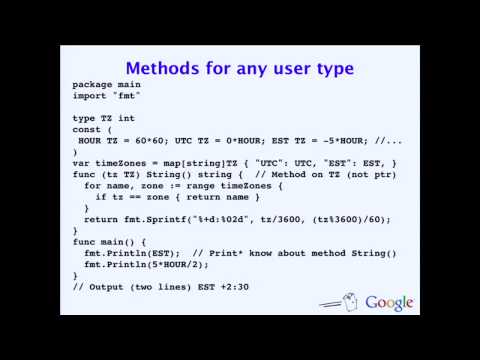
In briefRob Pike's October 2009 Google Tech Talk introducing Go, a new experimental systems language designed for fast builds, concurrency and garbage collection. It covers the goals, syntax and type system.
Page 33 of 41
In briefRob Pike's October 2009 Google Tech Talk introducing Go, a new experimental systems language designed for fast builds, concurrency and garbage collection. It covers the goals, syntax and type system.
In briefHillel Wayne reports on interviews with 17 people who have worked as both software and traditional engineers. He argues the fields are fundamentally the same and have much to learn from each other.
In briefAndrew Kelley's 2024 Zig roadmap talk, followed by a Q&A, covers the language's priorities and the state of the project. Topics include compilation speed, moving off LLVM toward a self-hosted toolchain, async, and the path to 1.0.
In briefA long Mill Computing lecture on the Mill CPU's compiler toolchain, covering the specializer that targets family members, scheduling and latency passes, and the belt. It explains how the compiler handles a wide-issue, exposed-pipeline design.
In briefJonathan Blow's Reboot Develop 2017 talk on making game programming less terrible, discussing software bloat, slowness and the design goals behind his own programming language.
In briefA ten-minute clip from Jonathan Blow's talk on preventing the collapse of civilization, arguing that software quality and the knowledge to build it are in decline.
In briefA short TFiR clip in which Linus Torvalds explains his view that respect should be earned rather than given, in defense of his blunt and insulting style.
In briefChandler Carruth's GoingNative 2012 talk on Clang, covering how the compiler helps defend C++ code from mistakes. It makes the case for Clang's diagnostics and tooling.
In brief2kliksphilip examines UserBenchmark, a hardware comparison site known for strongly biased, pro-Intel writing. The video explains the site's credibility problems and points viewers to better sources for CPU and GPU information.
In briefRon Garret tells the story of the Remote Agent Experiment on NASA's Deep Space 1, where autonomous software controlled a spacecraft in 1999. He describes debugging Lisp code remotely from millions of miles away.
In briefJames Gosling gives a personal talk at the 50th anniversary seminar of Simula about using the language from 1974 and how it shaped his thinking. He explains how Simula's object model and coroutines influenced the design of Java.
In briefAdam Tornhill's GOTO Copenhagen 2019 talk on how to prioritize technical debt in large codebases. It argues for combining code complexity with change frequency (hotspots) from version control data, rather than trying to quantify debt in the abstract.
In briefA long personal account by a former NixOS contributor of his experience in the community, his ban and the governance events. He aims to correct what he sees as a false narrative about the NixOS drama.
In briefA five-minute demo of the Common Lisp debugger fixing a bug, recompiling a single function, and resuming execution from the failed stack frame. It shows how to avoid re-running long computations.
In briefRobert C. Martin (Uncle Bob) presents the principles of Clean Architecture, covering dependency direction, boundaries, and why frameworks and databases should be details rather than the center of an application.
In briefGitHub interviews Linus Torvalds on twenty years of Git, from its creation in about ten days as a Linux kernel tool to its role in modern software development. He discusses technical decisions, community contributions and the project's philosophy.
In briefA roughly ten-minute demo of Microsoft's Intentional Programming research system, showing its editor and an unusual way of working with code. It is the first of two clips cut from a longer video.
In briefA 2015 GDC talk by Bungie's Barry Genova on how Destiny's engine was restructured into a job graph with limited thread pre-emption. It is aimed at programmers of demanding game engines.
In briefAn excerpt from Hal Abelson's opening SICP lecture introducing computer science and contrasting declarative and imperative knowledge. He argues that computer science is not really a science and is more like magic or engineering of ideas.
In briefThe Michigan TypeScript group shows the Doom engine running entirely inside the TypeScript type system. It is open source, and two follow-up videos cover why and how they did it.
In briefAn AdaCore talk on the history, present and future of the Ada language, including remarks from Robert Dewar. The title and description say little else.
In briefChristian Schafmeister presents CANDO at the 2016 European Lisp Symposium. It is a compiled Lisp-based language for designing macromolecules and nanoscale materials, built on the Clasp implementation of Common Lisp.
In briefA family comedy video in which kids write instructions for making a peanut butter and jelly sandwich, and a parent follows them with exact literalness, producing chaos. This is the classroom-friendly version.
In briefJosh Wardle, later the creator of Wordle, talks at SF Tech Poetics about why April Fools' Day in Silicon Valley is often lame. He shares lessons from building The Button and Place at Reddit.