Where GREP Came From - Computerphile
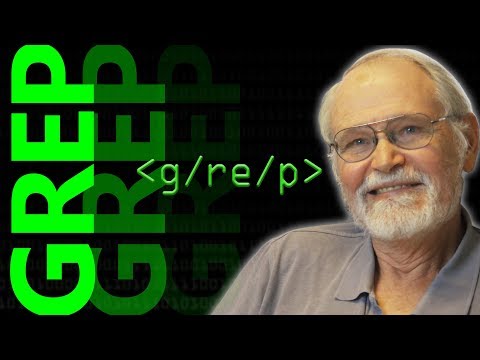
In briefBrian Kernighan explains how grep came to be, written overnight by Ken Thompson, and how it got its name from the ed command g/re/p. He also covers the lineage from QED to ed that led to it.
Page 30 of 41
In briefBrian Kernighan explains how grep came to be, written overnight by Ken Thompson, and how it got its name from the ed command g/re/p. He also covers the lineage from QED to ed that led to it.
In briefBryan Cantrill's OSCON 2015 talk on moving a proprietary product to open source, drawing on Sun's history with Solaris and illumos, licensing choices and the relicensing after Oracle's acquisition.
In briefA Thoughtworks conversation among Martin Fowler, Kent Beck and David Heinemeier Hansson on whether TDD is dead. They discuss the tradeoffs of test-driven development, mocking and where TDD helps or hurts design.
In briefA comedy sketch by Kai Lentit in which a senior JavaScript developer is interviewed, parodying the chaos of the JavaScript ecosystem.
In briefMorten Rand-Hendriksen argues that CSS Grid changes web layout, showing how to place content in cells independent of HTML source order and reshape layouts with media queries. It makes the case for using Grid now that browsers support it.
In briefLouis Rossmann explains why he stopped using GrapheneOS, describing his interactions with its lead developer Daniel Micay. It includes chat logs shown in the video.
In briefA one-minute archive video of the 2Advanced Studios v2 website from 2001, a showcase of the elaborate futuristic Flash interfaces the agency was known for.
In briefLecture 7A from MIT 6.001 (SICP) by Abelson and Sussman introduces the metacircular evaluator, a Scheme interpreter written in Scheme. It shows how evaluating a program is itself a program.
In briefThe winning demo from Revision 2015's oldskool competition, running on a real 1981 IBM PC with CGA at 4.77MHz. It uses extreme tricks to produce effects, graphics and sound far beyond what the hardware was thought capable of.
In briefTom Dale explains the internals of the Glimmer VM, Ember's rendering engine, which compiles templates to opcodes. The talk includes a performance benchmark demo.
In briefJohn Romero's 2016 GDC Europe talk recounts the early days of id Software and the programming principles behind Doom and Quake, including fast iteration and keeping the game bootable.
In briefDylan Beattie's parody of 'We Didn't Start the Fire' with lyrics made entirely of real software framework names, ending in the chorus about building yet another framework.
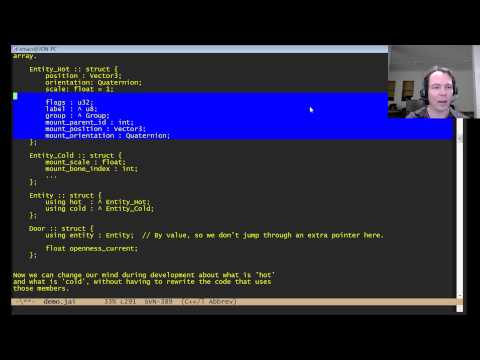
In briefA live-coded demo by Jonathan Blow showing how to get object-system-style expressiveness in a data-oriented way, covering structure-of-arrays layouts and composition. It shows features of his Jai language that make programs fast.
In briefAlan Kay's 1997 OOPSLA keynote argues that the computer revolution has not really happened yet, reflecting on how computing, objects and the web fall short of their potential.
In briefBrandt Bucher presents his prototype JIT compiler for CPython at the 2023 Core Developer Sprint. He explains the copy-and-patch approach, the implementation and its performance.
In briefA five-minute lightning talk from React.js Conf 2016 by Elie Rotenberg on protecting the DOM from tampering. It shows how React tree obfuscation (react-armor) can shuffle class names, tags and tree structure to defeat CSS-selector-based ad blocking.
In briefAndrei Alexandrescu's ACCU 2016 talk previews material from his book on writing fast code, with a focus on optimization techniques such as sentinels and faster search.
In briefA short demo showing slow 2D drawing in the Windows 7 GUI compared with XP. It attributes the slowdown to the display driver model lacking hardware accelerated GDI.
In briefSteve Yegge's OSCON Data 2011 talk imagines what you could do with Google-scale storage and compute a decade later. He argues smart people should work on hard problems such as biology rather than cat pictures, and the talk ends with a moment many took as him quitting Google.
In briefAndrew Rota of Wayfair argues at React.js Conf 2015 that React and native Web Components complement each other. He shows how they can be combined for complex web applications.
In briefA screencast tutorial on Specter, a Clojure library for navigating and transforming nested data structures declaratively, demonstrated in a REPL.
In briefJohn McCutchan of Google explains how Dart and the Dart VM expose SIMD instructions to speed up web software. He covers what SIMD is and how it applies to graphics and games.
In briefChandler Carruth's CppCon 2016 talk on designing hybrid data structures for performance. He covers cache locality, working-set size and allocation overhead, and why standard C++ containers fall short.
In briefA one-minute 2012 Microsoft television commercial for Internet Explorer 9, set to Alex Clare's 'Too Close'. It pitches a 'more beautiful web' with fast one-click access to favorite sites.