Tabs Outliner Overview
In briefA short overview of Tabs Outliner, a Chrome extension that shows browser tabs and windows as a nestable tree. It demonstrates organizing, saving and restoring tabs.
Page 14 of 41
In briefA short overview of Tabs Outliner, a Chrome extension that shows browser tabs and windows as a nestable tree. It demonstrates organizing, saving and restoring tabs.
In briefThe first lecture of Stanford's CS107 Programming Paradigms, taught by Jerry Cain, giving an overview of the course. The course goes from C and assembly through C++, concurrency, Scheme and Python.
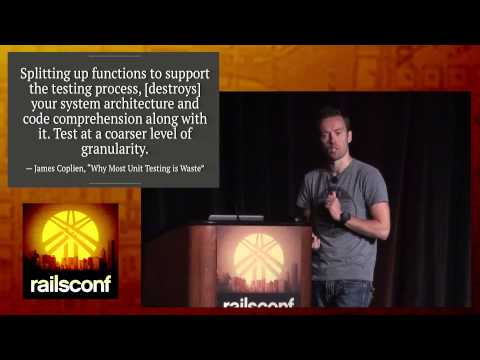
In briefDavid Heinemeier Hansson's opening keynote at RailsConf 2019 argues against the expectation of payment for open source work, drawing on his experience releasing Rails. It also includes lighter asides about the industry.
In briefJ. B. Rainsberger argues that large integrated tests are a scam: they are slow, fail opaquely, and give a false sense of coverage. He advocates focused collaboration and contract tests at boundaries instead.
In briefPeter Seibel's 2006 Google TechTalk on Practical Common Lisp, framed by the Sapir-Whorf hypothesis and Paul Graham's Blub paradox. It shows Lisp features such as condition restarts and its generic-function object system.
In briefA seven-minute demo from the author of Notcurses, a C library for text user interfaces. It shows the 2.3.0 release, which adds Sixel and Kitty bitmap graphics integrated into its multiplane character-graphics model.
In briefA two-minute 2008 clip from Sun's Fishworks team in which Brendan Gregg uses DTrace to show disk latency spiking while he shouts at a rack of drives. Bryan Cantrill narrates the demonstration.
In briefAnders Hejlsberg whiteboards how compilers are taught versus how modern ones are actually built. He explains the shift to compilers as services with incremental, error-tolerant, IDE-oriented design, as in Roslyn and TypeScript.
In briefAditya Siram introduces ATS, a statically typed ML-like language that compiles to C and offers type-safe pointer arithmetic and a full proof language. The Strange Loop talk shows off C interop, concurrency and verification features with non-trivial examples.
In briefA demo of writing technical documents in Emacs Org mode using org-babel, so that code blocks and generated content stay consistent when things change. The author shares the demo files and his dotfiles.
In briefA roughly hour-long live hacking session in which Go team members Andrew Gerrand and Brad Fitzpatrick write the new version of tip.golang.org, the site serving leading-edge Go documentation. It is unedited pair programming on a real Go project.
In briefDavid Guillot describes how his team replaced a two-year-old React UI of their SaaS product with Django templates and htmx in a couple of months. The talk gives concrete indicators on code size, performance and team impact.
In briefPatricia Aas's EuroBSDCon keynote is about ethics for people who build software, covering how the tech industry got to its current state and what engineers can do about it. It steps back from technical detail to the bigger picture.
In briefModern Vintage Gamer examines the claim from the Super Mario 64 decompilation project that the game shipped unoptimized, and puts it in the context of 1996 N64 development.
In briefJafar Husain's ACM keynote presents Netflix's JSON Graph and Falcor, which let web developers treat all cloud data as one virtual JSON model. It combines reactive programming with REST principles.
In briefEdwin Brady presents Idris 2, a rewrite of the Idris dependently typed language, and shows type-driven development in practice. The demos show the compiler filling in whole functions from their types.
In briefDavid Ungar of IBM Research reflects at Stanford on the Self language project and argues the real legacy of ideas is the people. He covers its history, philosophy, successes and failures.
In briefDavid Heinemeier Hansson's RailsConf 2014 keynote argues that programming is closer to writing than to science, with clear code produced by iterating through drafts. It prioritizes clarity and craft over technical superiority.
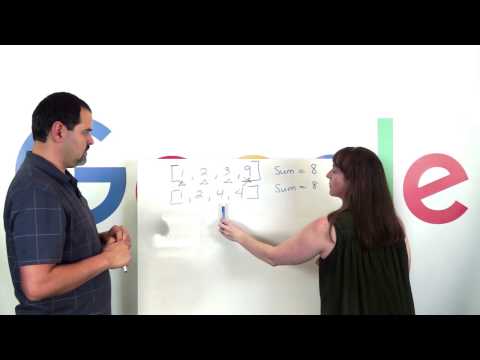
In briefTwo Google engineers perform a mock coding interview and then discuss best practices for candidates, including asking clarifying questions and communicating while solving.
In briefA 1975 live demonstration of the APL language by Imperial College professor Bob Spence, showing a REPL on a modified typewriter terminal and APL's appeal to non-programmers.
In briefChandler Carruth's CppCon 2016 talk tries to defuse the heated debate over undefined behavior in C and C++. He explains from the compiler writer's perspective why UB exists and how it enables optimization.
In briefDavid Nolen presents Om Next, the redesign of the ClojureScript Om library, drawing on Relay, Netflix's JSONGraph and Datomic. He covers the tradeoffs in handling the client-server boundary over immutable data.
In briefMoishe Lettvin, a former Google engineer, shares lessons from 250 interviews and his time on the hiring committee. He tells how the committee given anonymized packets, including its own, would hire almost none of them.
In briefRobert Erdmann, a materials scientist at the Rijksmuseum, gives a PyCon keynote on the ultra-high-resolution imaging of Rembrandt's Night Watch. He covers the automated gantry camera system, the Python software that drives it, and the large volumes of image data involved.