Your toothbrush is worn-out!
In briefBen Krasnow of Applied Science uses a scanning electron microscope to compare new and worn toothbrush bristles. He shows how the microscopic texturing wears down with use.
Page 20 of 25
In briefBen Krasnow of Applied Science uses a scanning electron microscope to compare new and worn toothbrush bristles. He shows how the microscopic texturing wears down with use.
In briefLockPickingLawyer shows what happens when liquid gallium is applied to an aluminum Abus padlock, which weakens and breaks the metal. It is a short demonstration of gallium's effect on aluminum.
In briefA short MIT Math Lab video showing millimetric droplets bouncing and walking across a vibrating fluid bath, guided by their own pilot waves. These droplets show diffraction, tunneling and quantized orbits, which were once thought to belong only to quantum systems.
In briefA short film in which friends build the first true-to-scale model of the solar system, with full planetary orbits, on a Nevada dry lakebed. It conveys the real distances and sizes involved.
In briefTech Ingredients shows how to build a liquid panel with a specialty paint that, placed outside, cools below ambient air temperature. It demonstrates radiative sky cooling.
In briefProfessor Mike Merrifield of Nottingham explains in a mostly uncut conversation why light travels slower in glass. He treats light as a wave and describes how the material's electrons produce secondary waves that combine to slow it.
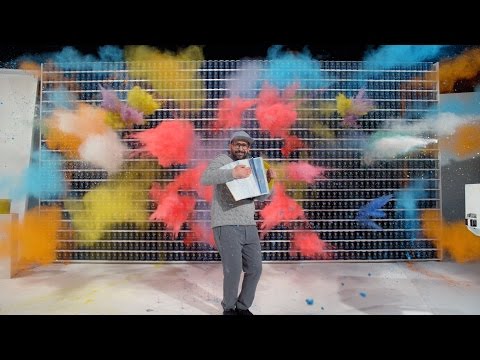
In briefOK Go's music video for The One Moment, in collaboration with Morton Salt. It is a choreographed real-time scene that took about 4.2 seconds to film and is shown slowed down to the length of the song.
In briefA one-minute New Scientist clip showing a Japanese experiment in which drivers on a circular track produce a spontaneous traffic jam that travels backward. It illustrates phantom traffic jams without any obstacle.
In briefDestin Sandlin of Smarter Every Day explains how a US Navy nuclear submarine surfaces through Arctic ice, filmed during the ICEx exercise. It shows ballast and control systems and the physics involved.
In briefTom Scott tours the rotating room artificial gravity facility at Brandeis University's Graybiel lab. It shows how humans cope with rotation-based gravity and the odd effects such as Coriolis forces.
In briefAstrophysicist Dr. Becky explains the Hubble tension, the disagreement between expansion-rate measurements from the cosmic microwave background and the distance ladder, and what early JWST Cepheid observations add.
In briefNumberphile's Ben Sparks works through the physics of a car crash, showing how kinetic energy grows with the square of speed and why stopping distance climbs so quickly as velocity increases.
In briefA 105-minute technical deep dive from Noise In Space evaluating whether Starlink satellites could work as synthetic aperture radar. It covers SAR signal-to-noise, amplifiers, antennas, duplexing, phased array beamforming and simulations of V2 Mini and V3 satellites.
In briefThe Thought Emporium follows up on his earlier video showing negative ion products are radioactive, reporting that Amazon pulled listings and companies shut down. He tests more radioactive quack products with a Geiger counter and cloud chamber.
In briefKurzgesagt explores the idea that black holes could create universes and that we might live inside one. It builds up the physics of how density falls as black holes get larger.
In briefSpaceX footage of the Grasshopper vehicle's 744 m test hop, filmed from a hexacopter that gets closer than earlier flights. Grasshopper was a vertical takeoff and landing rig built to test returning rockets to the pad.
In briefTim Dodd of Everyday Astronaut gets a close-up walkthrough of SpaceX's Raptor 2 engine from Elon Musk at Starbase. They cover how Raptor 2 was simplified and upgraded relative to Raptor 1, including cooling and thrust vectoring details.
In briefIsaac Arthur examines Dyson spheres and swarms, including common myths and misconceptions. He covers uses such as interstellar travel, black hole generation, and computing large enough to simulate universes.
In briefVeritasium revisits Thomas Young's original double slit experiment with light, showing how interference supports the wave nature of light. It uses a pond-wave demonstration to explain the pattern.
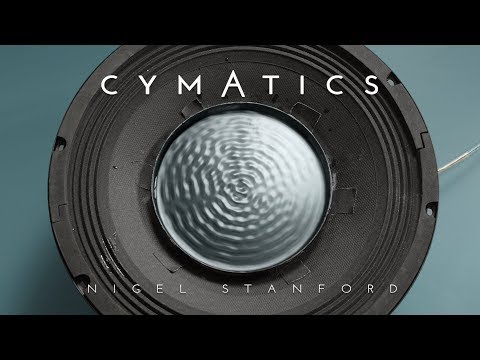
In briefNigel Stanford's music video Cymatics, in which real science experiments, such as Chladni plates, ferrofluid and water, visualize the audio.
In briefA short look at CoeLux, an artificial skylight that recreates the scattering process that makes the sky look blue, producing a convincing illusion of distant sun and depth.
In briefScott Manley explains the nuclear salt water rocket, Robert Zubrin's concept of a rocket fueled by a rapid nuclear reaction in uranium salt dissolved in water. He covers its extraordinary performance and the dangers of managing it.
In briefTom Scott follows the ISO 3103 / BS 6008 standard to make an international standard cup of tea, using specialist tasting equipment. The video shows how precisely the standard is specified.
In briefSteve Mould explains motion amplification and video magnification, techniques that find tiny changes in video invisible to the eye and exaggerate them. He covers the MIT research and industrial uses such as diagnosing vibrating machinery.