Alvin Lucier - I Am Sitting In A Room
In briefAlvin Lucier's 1969 minimalist piece in which a spoken text is repeatedly played back and re-recorded in a room until the room's resonances replace the words. This is the 1981 Lovely Music recording.
Page 18 of 25
In briefAlvin Lucier's 1969 minimalist piece in which a spoken text is repeatedly played back and re-recorded in a room until the room's resonances replace the words. This is the 1981 Lovely Music recording.
In briefDaniel Radcliffe performs his party trick on The Graham Norton Show: singing Tom Lehrer's 'The Elements', the periodic table song, from memory. It is a two-minute talk-show clip.
In briefQuanta Magazine explains the 2022 experiment that claimed to create a holographic wormhole on Google's quantum computer. The description now notes that a later independent analysis questioned whether any wormhole was created.
In briefPBS Space Time examines the Silurian hypothesis, the idea that an industrial civilization could have existed on Earth before humans. It looks at what traces such a civilization might leave in the geological record.
In briefA step-by-step guide to building a lifter, a small triangular ionocraft made from balsa wood, aluminum foil and thin wire, powered by a high-voltage supply. It also shows high-voltage safety practices.
In briefA NASA Langley concept video for HAVOC, a lighter-than-air vehicle that would carry two astronauts on a 30-day mission in Venus's upper atmosphere. It explains why the planet's surface is so hostile and why the clouds are more habitable.
In briefFootage of an unmanned Apollo boilerplate capsule launched on a Little Joe II booster to test the launch escape system. The booster went out of control and broke up, but the escape system worked and the capsule was recovered undamaged.
In briefRandall Munroe of xkcd answers what would happen if you swam in a spent nuclear fuel pool, and how much radiation you would receive at the surface versus at depth.
In briefA three-minute minutephysics video on the orbital mechanics of why crashing into the Sun takes far more energy than leaving the solar system.
In briefThunderf00t debunks the Fontus self-filling water bottle, arguing that pulling meaningful amounts of water from air with a small solar-powered device is thermodynamically impractical.
In briefRoyal Institution lecture by Dr Kate Lancaster on the most powerful lasers in the world and the extreme conditions they create. It includes live demonstrations and covers applications from industry to fusion.
In briefNeuroscientist Beau Lotto runs the audience through color and pattern illusions to show that perception is shaped by context and evolutionary history rather than being a direct readout of the world. The talk is playful and hands-on, and it argues that the brain interprets ambiguous signals.
In briefBen Krasnow of Applied Science shows how to make and test YBCO high-temperature superconductor with a kiln and eBay chemicals. He demonstrates flux pinning and shows a close-up of the crystal structure.
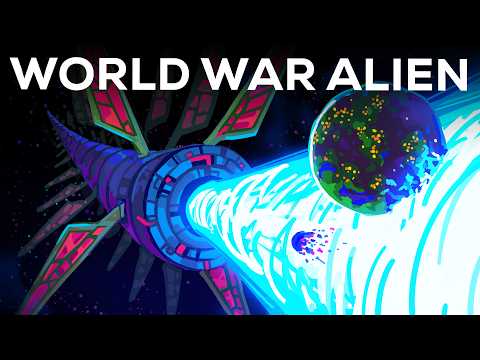
In briefA Kurzgesagt video exploring how advanced civilizations might wage war across light years. It looks at weapons such as relativistic beams and what they would do.
In briefA short experiment dissolving the aluminum of a Coca-Cola can with drain cleaner to reveal the clear plastic film lining inside.
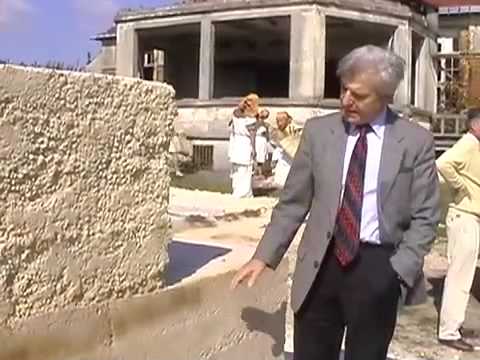
In briefThe Geopolymer Institute presents Joseph Davidovits's theory that the Egyptian pyramids were built from cast artificial limestone, a geopolymer concrete, rather than carved blocks. It demonstrates how few people could make blocks.
In briefGrace Hopper appears on Letterman and uses a foot-long piece of wire to show how far light travels in a nanosecond.
In briefKurzgesagt explores the idea that life might have arisen shortly after the Big Bang, when the whole universe was warm enough to be habitable. It discusses what that would mean for the origin and spread of life.
In briefKurzgesagt asks whether advanced civilizations could have existed on Earth in the deep past and left little evidence. It looks at time as a dimension for searching for alien civilizations and the limits of the geological record.
In briefNASA Goddard recreates the Apollo 8 Earthrise moment using Lunar Reconnaissance Orbiter data, narrated by Andrew Chaikin and synced with the astronauts' recorded conversation. It marks the flight's 45th anniversary.
In briefKurzgesagt explains the skyhook, a rotating cable with a counterweight that could catapult spacecraft from Earth orbit toward deep space. It covers why it would make space travel cheaper and more efficient.
In briefA NASA and Durham University supercomputer simulation suggesting the Moon may have formed within hours of a giant impact between Earth and a Mars-sized body. It is one of the highest-resolution giant-impact simulations run.
In briefFolk musician Peter Mulvey performs Vlad the Astrophysicist, a spoken-word style song that touches on why civilizations may never meet across space and time.
In briefThe Thought Emporium synthesizes chicken noodle soup from pure chemicals, following an original patent for artificial chicken flavor. The video explores how many chemicals it takes to make a convincing soup.