GDC 2010: Sid Meier Keynote - "Everything You Know is Wrong"
In briefSid Meier's GDC 2010 keynote on how players perceive probability in games, including how Civilization's odds were adjusted because players misjudged them.
Page 8 of 15
In briefSid Meier's GDC 2010 keynote on how players perceive probability in games, including how Civilization's odds were adjusted because players misjudged them.
In briefMartin Kleppmann surveys current research on CRDTs, the algorithms for merging concurrent edits across offline replicas. He covers the hard parts such as rich text, moves and merge results that are technically correct but poor.
In briefPolylog explains how algorithms can be turned into circuits and encoded as satisfiability problems, which lets you effectively run them backwards. It uses this to motivate breaking RSA, general reductions to SAT, and what P vs NP is really asking.
In briefAdam Neely's Ableton Loop 2017 talk links rhythm, pitch and synaesthesia. He shows that polyrhythms sped up become chords, so tempo and pitch are related by ratios.
In briefGrant Sanderson of 3Blue1Brown shows his workflow for animating math videos with Manim, with Ben Sparks. He codes scenes live, including a Lorenz attractor, and walks through example scenes.
In briefSabine Hossenfelder asks whether complex numbers are just a convenient tool or necessary in physics. She discusses a recent paper arguing that quantum mechanics cannot be done with real numbers alone.
In briefMinutePhysics explains Shor's algorithm, showing how a quantum computer factors large integers by finding the period of a number modulo N. It walks through the modular arithmetic and number theory that give the exponential speedup over classical factoring, and why this threatens encryption.
In briefA short CGP Grey animation showing how the US electoral college lets a candidate win the presidency with as little as about 22 percent of the popular vote. It lays out the arithmetic of winning states by narrow margins.
In briefThe old announcement trailer for Hyperbolica, CodeParade's Unity game set in hyperbolic and spherical space. The creator has since posted devlog videos on building it.
In briefA two-minute demonstration of the loudness war, showing how heavy dynamic range compression in CD mastering makes music louder while degrading sound quality. It uses audio examples so you can hear the distortion.
In briefAlphaPhoenix uses Monte Carlo simulation and annealing-style methods to draw North Carolina congressional district maps, both gerrymandered and fair. He focuses on the fascinating computational problem rather than the politics.
In briefDaniel Lemire's QCon talk on how simdjson parses gigabytes of JSON per second. It covers SIMD vectorization, branch prediction and the lessons learned building a fast parser.
In briefTimur Doumler's CppCon 2015 talk on how C++ is used in the audio industry. It covers the patterns and tools audio developers rely on, including handling real-time constraints.
In briefThe first lecture of Michael Sipser's MIT 18.404J Theory of Computation course, covering course mechanics, finite automata, regular languages and regular expressions. It proves closure of regular languages under union and begins concatenation.
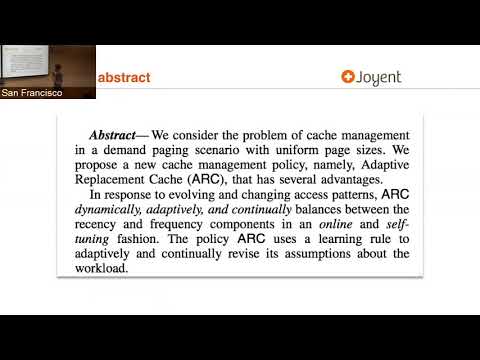
In briefBryan Cantrill presents the ARC (Adaptive Replacement Cache) paper by Megiddo and Modha at Papers We Love. He opens with a survey of caching strategies before digging into the self-tuning LRU/MFU design.
In briefVsauce asks how many holes a human has and uses topology to show the answer depends on what counts as a hole, with animations and expert input.
In briefAaron Hsu shows how to manipulate and transform tree data in APL using arrays and inverted tables instead of pointers. He claims much smaller code, better performance and easier parallelisation.
In briefTerence Tao and Grant Sanderson of 3Blue1Brown walk through the cosmic distance ladder, showing how humans measured distances from the Earth to the Moon, Sun, planets and beyond. It includes animations and the history behind each step.
In briefDaniel J. Bernstein and Tanja Lange survey recent highlights in post-quantum cryptography at 35C3, covering the NIST competition, network protocol experiments, and broken candidates.
In briefJohn Gustafson presents posits, a proposed drop-in replacement for IEEE 754 floats that is simpler in hardware and more flexible in precision. The seminar includes a live demo and machine learning results.
In briefThe first of an eight-part ScienceClic series building general relativity, covering worldlines, proper time and coordinate systems with animated visualizations.
In briefThe first lecture of David MacKay's Cambridge course on information theory, pattern recognition and neural networks. It introduces the core ideas of his book Information Theory, Inference, and Learning Algorithms.
In briefAndres Gomez Emilsson of the Qualia Research Institute presents a model of DMT experiences using hyperbolic geometry and dynamical systems theory. He describes how different intoxication levels correspond to changing curvature and information content of experience.
In briefPBS Infinite Series explains how Shor's algorithm lets a quantum computer break RSA encryption, building on earlier episodes about cryptography and the math of quantum computers. It works through the idea step by step.